Advertisement | Inspiration for Balcony and Terrace
7 Reasons Why You DON'T Need a Large Garden to Grow Your Own Vegetables
How a small empty space on the balcony can become your very own vegetable garden!
Dustin Franken · 07/26/20 · 2 min read
Anyone who wants to grow their own vegetables often thinks of a large garden.
- Long rows of beds.
- A greenhouse.
- A tool shed.
- And plenty of open space.
This quickly leads to the conclusion:
It's not even possible in my apartment anyway.
But for a first small vegetable garden, you don't necessarily need a plot of land.
Above all, you need a suitable location, sufficient light, regular care, and a system that can handle limited space.
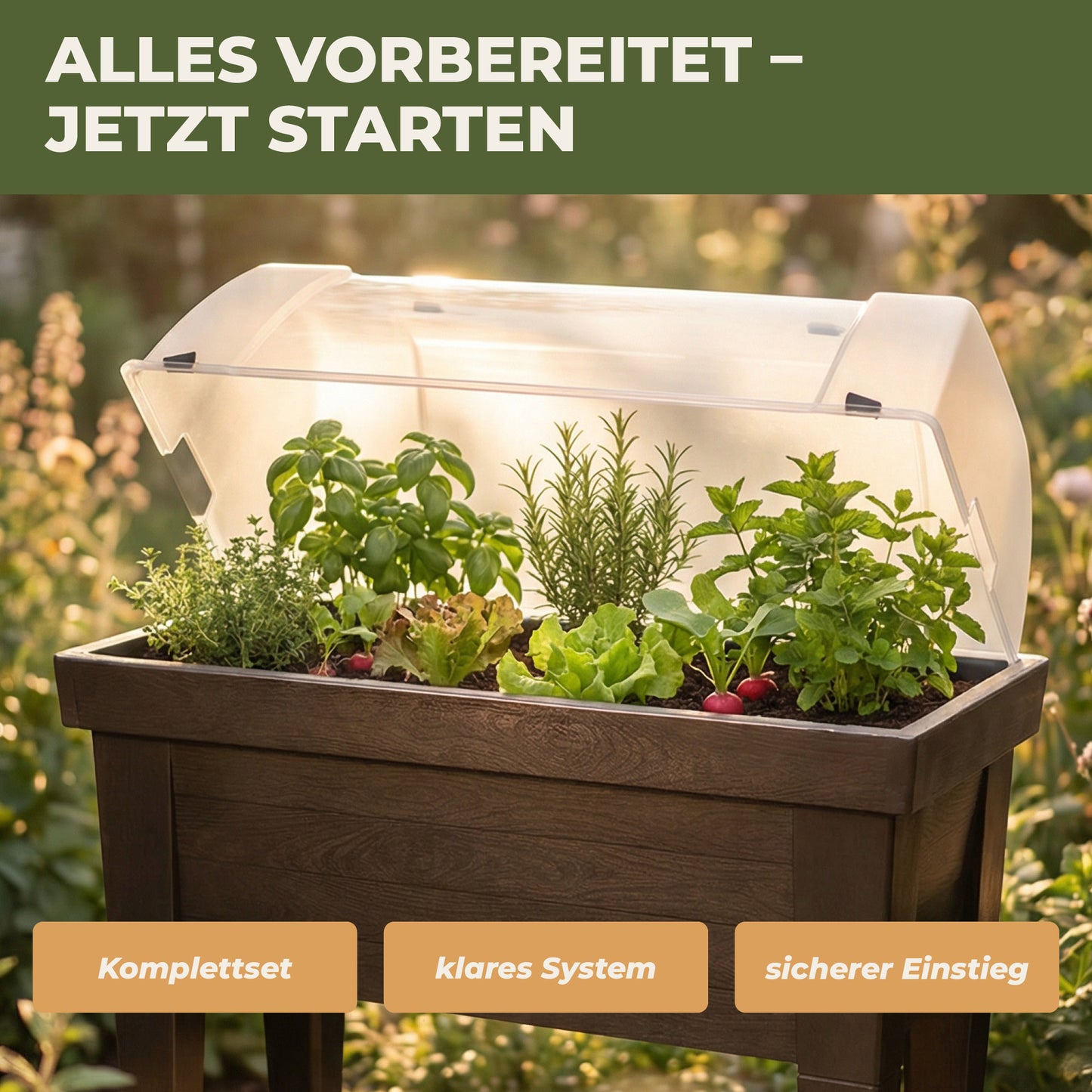
The raised bed complete set was developed for balconies, terraces, and gardens.
With a base area of 100 × 50 cm, it only uses a manageable space. At the same time, the elevated planting area offers space for various types of vegetables and herbs.
Here are seven reasons why a balcony has more potential than many people think.

1. Half a square meter can already make a difference
A balcony doesn't have to become a full-fledged vegetable garden.
You don't need ten planters or a complete redesign.
The raised bed requires a footprint of approximately half a square meter.
That corresponds to 100 × 50 cm.
Before you order, you should precisely measure the intended space and check whether doors, walkways, and seating areas remain usable.
If the bed fits in the intended location, you can make good use of a previously unused area.
A bare corner becomes a cultivation area.
A spot next to the balcony door becomes a location for herbs and vegetables.
The balcony remains your balcony.
It simply gains a new function.

2. You can harvest directly from your kitchen
The path from the bed to the kitchen can be just a few steps.
You open the balcony door.
Cut fresh herbs.
Harvest lettuce or radishes.
And use them directly for your meal.
This doesn't mean that a single raised bed will cover all your vegetable needs.
But it does mean that you can watch a portion of your food grow and harvest it yourself.
Especially herbs are often sold in supermarkets in quantities that are not fully consumed.
If they grow right outside your door, you can cut only as much as you need at the moment.
The benefit is not just functional.
It also changes your relationship with food.
You don't just see the finished product.
You see how it comes into being.

3. The raised bed uses height instead of additional ground space
Space on a balcony is limited.
Therefore, it makes sense not to think only horizontally.
The raised bed is 107 cm high.
This places the planting area above the ground and allows it to be integrated into the balcony without you having to create a classic garden bed.
Underneath the planting area, a different visual effect is created than with numerous individual pots.
Instead of ten different containers, you get a cohesive growing area.
This can look tidier and makes it easier to arrange plants according to a common plan.

4. You don't have to coordinate heavy individual purchases
Anyone living in a city apartment knows the problem:
Ordering a raised bed is one thing.
Transporting several sacks of soil, fertilizer, and seeds from different shops home is another.
Without a car, this quickly becomes impractical.
The complete set bundles the most important components:
✓ Raised bed
✓ suitable soil
✓ organic fertilizer
✓ ten varieties of seeds
✓ four herb seed discs
✓ instructions and planting plan
You won't have to find out after buying the raised bed that you're still missing half the items.
The system comes to you as a common starting point.

5. The planting plan helps to make good use of the available space
The smaller the area, the more important its layout.
A large plant can shade smaller varieties.
Plants placed too closely together compete for space and nutrients.
An unplanned mix can lead to inefficient use of the available space.
The enclosed planting plan divides the area according to different plant groups.
This way, you don't have to calculate yourself how to arrange the individual varieties.
You get clear guidance for:
- main yield,
- compact vegetable varieties,
- fast-growing plants,
- and herbs.
This is especially helpful if you haven't planned a garden bed before.

6. A balcony raised bed can become a visible part of your home
A planted raised bed is not just a usable space.
It changes the atmosphere.
Green spaces make a balcony feel more alive.
You observe growth directly from your home.
From the window, you see not just furniture or concrete, but plants that change from week to week.
The raised bed thus becomes part of the living space.
Not in the classical sense as decoration.
But as an area that is used, cared for, and developed.

7. You can decide anew each season what to grow
The included seeds are sufficient for approximately three to four seasons with normal use.
So you are not limited to a single planting.
In the first season, you will find out which varieties work particularly well at your location.
In the next season, you can adjust your layout.
Perhaps you want more herbs.
Perhaps more lettuce.
Perhaps you discover that a certain tomato variety needs a lot of sun.
This is exactly how a one-time project becomes a long-term balcony garden.
Does the raised bed fit on your balcony?
Before purchasing, check the following points:
✓ Space
You need a free area of at least 100 × 50 cm. Additionally, plan sufficient space for opening, tending, and harvesting.
✓ Location
Observe how many hours of sun the intended spot receives. Different plants have different light requirements.
✓ Load-bearing capacity
A filled raised bed is significantly heavier than the empty product. If in doubt, check the permissible load of your balcony or ask your landlord, property management, or a qualified expert.
✓ Water drainage
Ensure that excess water can drain off in a controlled manner and that neighbors or parts of the building are not affected.
✓ Access
Doors, escape routes, and necessary walkways must remain clear.
Transform your balcony into your own little vegetable garden
Raised Bed Complete Set for Balcony, Terrace, and Garden

Green Home Love Nature
Raised Garden Bed Complete Set – fresh vegetables from your balcony



Incl. Startup Success Guarantee ⚜️
If nothing grows after 30 days, you get your money back.
(Instructions followed – we bear the risk.)
